LA FOUNTAINE DE VAUCLUSE
and l'ISLE SUR LA SORGUE
Petrarch, Dante, (mononymously), Jacques Cousteau, speleologists, the Romans ...
QUESTION: What do they all have in common?
ANSWER: Each had a part to play in the history of the famous Fontaine de Vaucluse.

Fontaine de Vaucluse means Springs of Vaucluse. This wonderful place is located in the northwest part of Provence where you will find Vaison-la-Romaine, Mont Ventoux, Carpentras, and a great many other places of interest. Fontaine de Vaucluse is the source of the River Sorgue.
A few days before our arrival here, we visited the wine cellars of Robert Laurent, Domaine Combe Julienne in Rasteau (about a 10-minute drive from Vaison). M. Laurent asked me where we had been in France and was there more that we wanted to see before leaving Provence?
"We are planning a day trip to Orange," I said.
"Have you seen Fontaine de Vaucluse?" he asked.
I told him we had not and he said that he would choose Fontaine de Vaucluse over Orange any time. And if we were to go there we would not be disappointed. We were not. We would see Orange another time.


Fontaine de Vaucluse is the deepest subterranean spring in France and the fifth largest in the world. Precipitation falling on the vast surface area of Mont Ventoux and the surrounding mountains seeps into the rock and limestone. Water drains through the fractures causing multiple submarine channels, underground rivers and lakes.

Spelunkers (cave explorers), divers (Jacques Cousteau and his Calypso Group), geologists and hydrologists have unravelled many of the mysteries surrounding the famous spring.

Waters rise up 308 metres to the surface from a vertical abyss below, and a rock face rises another 200 metres from where the water surfaces.

I took the photo (below) at low water in October when the spring percolates up through the stream bed about 100 meters from the source.
☜
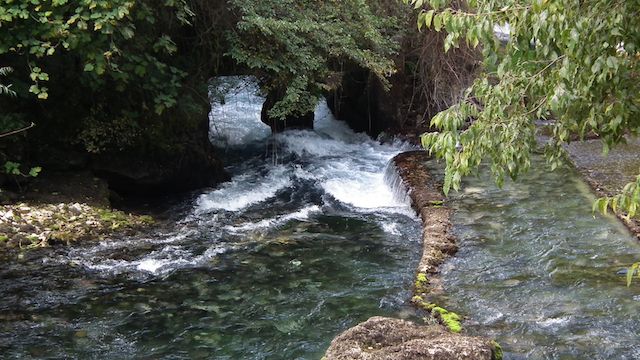
Downstream, after passing over several cataracts and weirs the current abates and pools, then flows on to form the Sorgue River.

The water is a cool crystal clear emerald green coloured by the aquatic flora—Sium Officinalis (I looked it up). And rich carpets of moss are the rare Hedwigia Aquaticus.


Roman ruins can be seen along the waterway. The ruins of the castle overlooking the river was once a Roman fortress. The Roman name for the settlement here was Vallis Clausa or dead-end valley. Now known as the Vaucluse.
 |
| Petrarch and Dante? One can hardly take in Fontaine de Vaucluse without also following the river down to the beautiful canal city of L’Isle-de-la-Sorgue. The city has only about 17,000 full-time residents. It lies 25 kilometres east of Avignon, and is a couple of hours' drive south of Vaison-la-Romaine where we were staying. |
 |
| Scene from over the dam built by the Romans |
This ancient island city has pre-Roman roots with a continuous and varied history of settlement and industry, politics and religion. The Romans drained the swampland here, dammed the Sorgue—the dam is still in operation at the northern edge of town—and built canals with more than 100 weirs to slow the flow of the currents.

Today L’Isle-de-la-Sorgue thrives on tourism. It is a Provençal Market town and is one of the largest centers in southern France for antiques.

There are close to 300 antique dealers and sellers of second-hand everything. But what really makes the city unique is that it owes its existence to the Fontaine de Vaucluse, the source of the remarkably clear flowing water that runs everywhere through town, alongside and under the ancient, narrow streets.

We spent a few hours in this “park and walk” city.
During an hour or so of rambling around with my camera, I counted seven moss-covered water wheels slowing spinning in the strong currents of the canals.

There were over seventy of these water wheels supplying power for the town’s cottage industries.

trout are plentiful in the shallow canal waters


restaurateurs are rather creative with their placement of tables.
… hmmm, cool on a hot day, fish nibbling at your toes and ducks begging for crumbs ...?


sign art in France is a photographer's canvas.


It was no surprise stumbling upon an old Deux Cheveaux. It was parked in front of the restaurant at Le Jardin de Petrarque.

The iconic Citroën 2CV can still be seen almost everywhere in France. Many are restored like the one in my photograph. Some are in excellent condition and they can be seen in all combinations of colours.
The Deux Cheveaux is one of France's most sought-after classic cars, much in demand for its nostalgic value. The Citroën 2CV had a production run from 1948 to 1990. This is a unique vehicle and I urge the reader to learn more about what made it so special.
… 1953 Autocar in a technical review of the car wrote of "the extraordinary ingenuity of this design, which is undoubtedly the most original since the Model T Ford". It was described by Car Magazine journalist and author L. J. K. Setright as "the most intelligent application of minimalism ever to succeed as a car."
- Wikipedia
At the end of the day, we drove back up north through Carpentras to Vaison-la-Romaine.


On the journey home, I reflected on the waterways of the region, feeling that I had a much clearer picture of the interplay of geography and human habitation in this area of France. The Mediterranean Sea to the south seeds the clouds that yield precipitation over the vast mountain range of the Vaucluse. Freshets, springs and streams flow down and expand into rivers, all of which are life-sustaining. The cycle continues, through periods of drought and flooding and human intervention.
.jpg)
Back in Vaison, we crossed over the old Roman bridge that spans the Ouvèze River.
The Sorgue had joined the Ouvèze southwest of Carpentras.

In the days ahead we will drive west following the flow of the Ouvèze to Avignon where it joins the Rhone River.
For more travel photography with local information visit my website.


.jpg)

