Thursday, October 25, 2012

MONT VENTOUX

MONT VENTOUX


What comes to mind when we hear the words, Mont Ventoux? For many of us, it is the Tour de France—the world's premier bicycle race: twenty-one tough days of competition with cyclists from all over the globe. The multiple stages cover approximately 3,200 kilometres. The finish line is always in Paris. One of the most gruelling stages is the ride up Mont Ventoux. Mont Ventoux (MV) has been a stage 14 times since 1951. We did it by car, from both approaches.


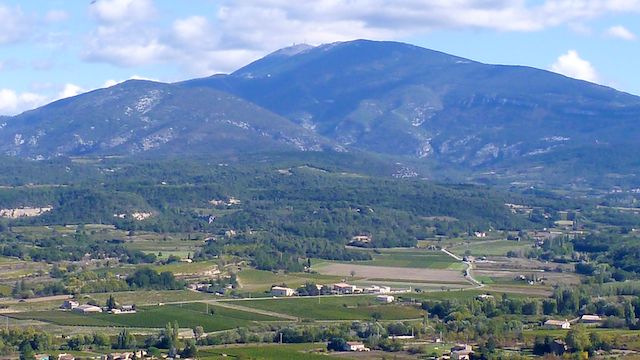
Every day during the first two weeks of October we would see MV from the house we were sharing with friends in Vaison-la-Romaine.


The peak looks snow-capped all year round but this is an illusion from afar. The top of the mountain is bare limestone. 

Mont Ventoux is on the Western periphery of the Alps. The Dentelles des Monmirail (October 21 blog posting) would be on the western tip of the Alps. MV appears all alone on the horizon for miles. It is situated in the Vaucluse, in the northwest corner of Provence between the cities of Carpentras, Vaison-la-Romaine and Avignon.


We drove up to the peak twice in good weather. The views were stunning. The T-shirt temperature in the valley is below but the sweater temperature is at the peak. Expect strong winds.


the cyclist below is approaching the final hairpin before the summit 


he just cycled through this


Below we see our cyclist who has just got off his bike, but his mate on the left is fatigued.


Now check out the white-haired dude who just came up the south side 
(looks a little like my friend Henry, back home)


He casually rides to the summit in high gear.


And he is not even looking tired - like a ride in the park!


Some guys ride up in style.


Me? I am out of training and now just like to watch.


Over my left shoulder is Mt Blanc, 15,781 feet high - the highest mountain in the Alps. It is about 360 km away, or say, 225 miles. With a real long lens, I could probably see the peak from where I am standing, which is pretty much at the top of Mount Ventoux at 6,272 feet in elevation. 


For more travel photography with local information visit my website.


ARLES and AIX-EN-PROVENCE

ARLES and AIX-EN-PROVENCE


Arles is known for a great many things: among the most intact Roman architecture and ruins in France; one of the best Provençal markets in France; Van Gogh's one-time place of residence where he painted hundreds of masterpieces, and where he cut off his ear; destruction of the Rhone side of the city during WWll by American bombers to roust the occupying  German army ....


We like Arles a lot because of its friendly people, the great outdoor market, and the vitality of the city as a thriving urban centre. Arles has retained its unique character as a major historical site in the south of France. It is just a short drive down along the Rhone River to the famous Camargue delta.


We drove up here from our Gites in the Camargue, about 40 minutes away, to shop at the Saturday market, and to lose our way in the maze of streets within the old city centre ...


The Cathedral St. Trophime is one of the finest examples of Romanesque architecture. It was built in the late 11th Century. It is well preserved and it is so spectacular that it stops you in your tracks. This church is one of the most photographed buildings in Arles. 


The tympanium above the portal depicts Christ seated in majesty, surrounded by symbols of saints. His 12 apostles (once disciples) are seated below. Unable to be seen in this photo are, on the left, a procession of chosen Christians going to heaven; and on the right, the sad procession of sinners cast into hell. So goes the litany, the redundant theme of all Christianity: freak out the masses, blind them with horror so that they may have unquestioned faith, and they will abide and the clerics will have hegemony forever and on ...

In 1365 Charles lV, was crowned King of Arles here. Arles was the second-largest city in Provence at the time. In 1801, its importance was downgraded when the Bishopric moved to Aix-en-Provence.


Arles is a city of art ...


some commissioned and some not. But it is all colourful.


rue Tardeau running down to the arena


Streets in the old city are slightly concave with stone gutters and hollowed-out stone doorsteps that allow rainwater to flow freely. rue des Arènes is one of these. The step on the right has recently been replaced but the more typical one on the left shows hundreds of years of wear.


--- ooo0ooo ---


The following Saturday we went to the market in Aix-en-Provence, and to explore a little. This is another favoured city, much larger than Arles. Aix is a university town, a bustling city with more locals than tourists. Aix is large enough to be able to absorb more tourists than Arles. Arles probably attracts more coach-loads of tourists because of the plethora of Roman ruins there and because of its proximity to the Camargue, in itself a big destination for summer holidayers and for retirees who have nothing but time on their hands.

Aix is a city of fountains. The one below caught my partner's attention. Its cold water is keeping the rosé chilled for customers at the adjacent cafe.


Aix is also known for its hot springs. The fountain of hot water on Cours Mirabeau is called Moussue (moss).


A lovely young woman was caught by my lens as she walked by the Fontaine de la Place d'Albertas.


For more travel photography with site information visit my website.


Monday, October 22, 2012

NIMES

NIMES


The Roman amphitheatre in Nimes is the best preserved in the world and it is still in use for major cultural events. Nimes has been on our list of must-see places for some time. We did the full tour with headsets, we got our money's worth and more.


Nimes is only a short drive up from where we were staying in the Camargue. It was a terrific day trip; the arena in the morning followed by a great lunch in Place de la Marché, then a good long ramble around the old part of town.


The Roman arena is actually two facing amphitheatres.


Spain brought bullfighting to this area in the 11th, and 12th Centuries. Amphitheatre then came to be called "arena" which in Latin means "sand".


Arles, nearby, has both an arena and an amphitheatre, restored and still in use for bullfighting, concerts and other events.

The Nimes Arena is among the 20 largest of the 400 Roman arenas still in existence. Its seating capacity is 24,000. BC Place Stadium, back home in Vancouver, is not a whole lot larger. Its seating capacity is almost 60,000 for (American) football and 21,000 for soccer. 


Vomitorium leading into arched corridors.


After the fall of Rome, Nimes and the surrounding regions were ruled by various invaders and finally, by the 13th Century, it became a centre dominated by the Catholic Christians and ruled by the crown of France: King Louis lX (St. Louis).


During the 16th Century Wars of Religion in France (Protestants versus Catholics) Nimes was more or less a Protestant stronghold.


The image of the cathedral on the right is taken through an arrow slot in the arena.


ROMAN GLADIATORS


Our travels through Europe on this and other trips have been like peering through a looking glass at the widespread architectural and infrastructure accomplishments of the Roman Empire. We have been walking in the footsteps of a people whose contributions to human development have outlasted many of the legacies of the various cultures that followed them. 

There have been numerous theories about the fall of the Empire, and historians have commented on the many contradictions in Roman society—democracy with slavery, the absence of freedoms for your average Mario and Belladonna, the morality issues of blood sport in the amphitheatres ....


The Roman arenas were used to entertain the masses. Hunters fought wild animals. Convicts were given over to the tigers for more bloodsport. The carnage was diabolical and the audiences were often mortified.


Note the 'vomitorium' above. The Latin word means "stairs connected with seating", but another meaning seems more apt ...

Chariot races were also common, especially in the bigger arenas like Circus Maximus and the Coliseum in Rome.

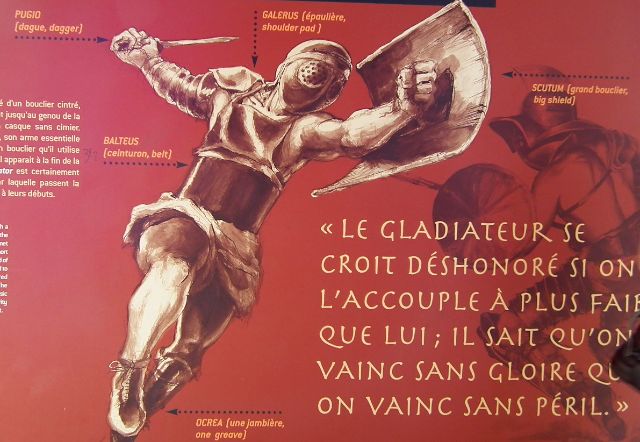
The sport of gladiatorial combat was the most athletic and the most glorious. The combatants were volunteers, well-trained and highly skilled. This is where heroes were made.


The gladiator seen above is the Hoplomaque from the 1st Century BC.


the Thrace 


the Rétiare


the Trident


the Scissor


the Mirmillon 


the Sécutor 


the Provocator 


The armour and weapons of these hellish warriors improved over time. Actually, the records show that  Mr. Hoplomaque and Mr. Thrace appeared in the 1st Century BC.

Scissorhands (way predecessor to Edward) was very effective against Mr. Trident, whose net met its nemesis against Mr. Sss.

Captain Mermillon and Papa Provocator did not appear until the end of the Republic.

Serious dudes, all these guys!

The life expectancy of the gladiator was in the late twenties.


---ooo0ooo--- 

We leave the arena and walk around the old town
Following are some photos. The Nîmois ignore us because they, like all the French people in these tourist centres of interest, are used to camera-happy foreigners and take little or no interest in us. But not so at the family-run Lebanese restaurant where we lined up for lunch. One of the two daughters who were serving had just come back home to Nimes after living a couple of years in Montreal. She could not renew her visa. Mother is an amazing chef. Dad is in the picture below. The family wants to move to Canada to start a restaurant there. Their English is good. They just cannot afford what Canada will charge them to immigrate and start their business - about $800,000!


Lebanese lunch


Sainte Eugénie Cathedral
After lunch, I lay down, looked up and saw the light, obscured ...


... but Lord how I have sinned
(this is really hard on the neck)


children the world over
we see these little urchins everywhere
they are the colour
they are the light
they make smiles
they create laughter
we miss our own
special ones


For more travel photography with local information visit my website.


Gary Karlsen's photography website