Showing posts with label King Louis lX. Show all posts

Monday, October 22, 2012

NIMES

NIMES


The Roman amphitheatre in Nimes is the best preserved in the world and it is still in use for major cultural events. Nimes has been on our list of must-see places for some time. We did the full tour with headsets, we got our money's worth and more.


Nimes is only a short drive up from where we were staying in the Camargue. It was a terrific day trip; the arena in the morning followed by a great lunch in Place de la Marché, then a good long ramble around the old part of town.


The Roman arena is actually two facing amphitheatres.


Spain brought bullfighting to this area in the 11th, and 12th Centuries. Amphitheatre then came to be called "arena" which in Latin means "sand".


Arles, nearby, has both an arena and an amphitheatre, restored and still in use for bullfighting, concerts and other events.

The Nimes Arena is among the 20 largest of the 400 Roman arenas still in existence. Its seating capacity is 24,000. BC Place Stadium, back home in Vancouver, is not a whole lot larger. Its seating capacity is almost 60,000 for (American) football and 21,000 for soccer. 


Vomitorium leading into arched corridors.


After the fall of Rome, Nimes and the surrounding regions were ruled by various invaders and finally, by the 13th Century, it became a centre dominated by the Catholic Christians and ruled by the crown of France: King Louis lX (St. Louis).


During the 16th Century Wars of Religion in France (Protestants versus Catholics) Nimes was more or less a Protestant stronghold.


The image of the cathedral on the right is taken through an arrow slot in the arena.


ROMAN GLADIATORS


Our travels through Europe on this and other trips have been like peering through a looking glass at the widespread architectural and infrastructure accomplishments of the Roman Empire. We have been walking in the footsteps of a people whose contributions to human development have outlasted many of the legacies of the various cultures that followed them. 

There have been numerous theories about the fall of the Empire, and historians have commented on the many contradictions in Roman society—democracy with slavery, the absence of freedoms for your average Mario and Belladonna, the morality issues of blood sport in the amphitheatres ....


The Roman arenas were used to entertain the masses. Hunters fought wild animals. Convicts were given over to the tigers for more bloodsport. The carnage was diabolical and the audiences were often mortified.


Note the 'vomitorium' above. The Latin word means "stairs connected with seating", but another meaning seems more apt ...

Chariot races were also common, especially in the bigger arenas like Circus Maximus and the Coliseum in Rome.

The sport of gladiatorial combat was the most athletic and the most glorious. The combatants were volunteers, well-trained and highly skilled. This is where heroes were made.


The gladiator seen above is the Hoplomaque from the 1st Century BC.


the Thrace 


the Rétiare


the Trident


the Scissor


the Mirmillon 


the Sécutor 


the Provocator 
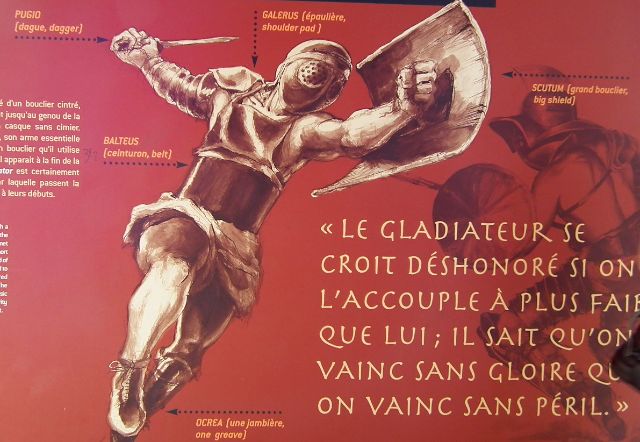


The armour and weapons of these hellish warriors improved over time. Actually, the records show that  Mr. Hoplomaque and Mr. Thrace appeared in the 1st Century BC.

Scissorhands (way predecessor to Edward) was very effective against Mr. Trident, whose net met its nemesis against Mr. Sss.

Captain Mermillon and Papa Provocator did not appear until the end of the Republic.

Serious dudes, all these guys!

The life expectancy of the gladiator was in the late twenties.


---ooo0ooo--- 

We leave the arena and walk around the old town
Following are some photos. The Nîmois ignore us because they, like all the French people in these tourist centres of interest, are used to camera-happy foreigners and take little or no interest in us. But not so at the family-run Lebanese restaurant where we lined up for lunch. One of the two daughters who were serving had just come back home to Nimes after living a couple of years in Montreal. She could not renew her visa. Mother is an amazing chef. Dad is in the picture below. The family wants to move to Canada to start a restaurant there. Their English is good. They just cannot afford what Canada will charge them to immigrate and start their business - about $800,000!


Lebanese lunch


Sainte Eugénie Cathedral
After lunch, I lay down, looked up and saw the light, obscured ...


... but Lord how I have sinned
(this is really hard on the neck)


children the world over
we see these little urchins everywhere
they are the colour
they are the light
they make smiles
they create laughter
we miss our own
special ones


For more travel photography with local information visit my website.


Gary Karlsen's photography website


Friday, October 19, 2012

CAMARGUE Pt 2

CAMARGUE
Part Two


Our sometimes travel companions, the Lucases, joined us on our second trip this year to the Camargue. 


fishing boats at Le Grau-du-Roi


We returned to Mas St Louis, the same Chambres d’Hôtes where we stayed a few weeks earlier. François and his friend Robert welcomed our return.


We shared the upper floor two-bedroom suite where we occasionally did our own cooking. More often, we prepared our meals at the al fresco kitchen. 


The daily swim in the pool was rather refreshing. While it was too cold for the locals, I assured François that we Canadians found it quite tolerable.


Mas St Louis is only about 5 minutes by car to the ancient city of Aigues-Mortes, one of the most popular centres in the Camargue.


aigues-mortes
means dead waters.
The Camargue is the delta of the Rhone River and it consists of lakes, lagoons, marshes, rivers and canals. 

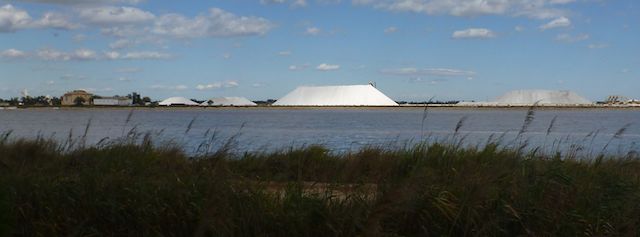
Salt production began here as far back as antiquity. The Romans engineered works to create a widespread and consistent supply. Today, SALINS produces salt using thousands of hectares of pools and land, stretching from 18 kilometres east-west and 13.5 km north-south. In the brochure, one reads that this is about the same area as Paris.


THE PROCESS: 

1. In early spring, ponds are filled with salt water and are trapped there.

2. Wind and sun facilitate evaporation resulting in concentrated salt, or brine.

3. From April to September crystallization forms salt cakes up to 9 mm thick. 

4. September is harvest month when salt cakes are lifted from the ground and trucked to the plant.

Looking out onto the salt fields in the fall, one can see the pink tint of crystals. This entire area is a protected wildlife heritage with very unique biodiversity. Flamingoes are only one of many birds that thrive here.


Q: Why are flamingoes pink?


A:  One of their major food sources is brine shrimp and their colour turns the birds' feathers pink.


The old medieval city of Aigues-Mortes is surrounded by a castle fortress that originated with the Knights Templar.

The statue of Saint Louis dominates the central square.
(sorry, no photo)


King Louis lX spent much time here and had a lot to do with the development of this area of France up until his death in 1270.


Louis was the only canonized French king, better known as Saint Louis. He has been much lionized throughout history, however, among his less celebrated deeds was his leadership role in the annihilation of the Cathars and his creation of the French Inquisition. The 13th century was a very dark time in the history of this part of the world.

The other two not-to-be-missed towns in the Camargue are Le Grau-du-Roi, 5 minutes drive to the west, and in the Camargue National Park, Les Saintes-Maries-de-la-Mer about 30 minutes to the east of Aigues Mortes.


These places are well worth visiting. The Camargue is a very unique region of the European continent. This vast delta of the Rhone is like nowhere else in France. The fascinating history and geographical diversity of the area, the flora and fauna, and the agriculture that yields a richness of local wines and foods will all delight the traveller. And there is no shortage of opportunities here for watersports or just plain relaxation on the sandy beaches of the Mediterranean.


NOTE: one might avoid coming to the Camargue in July or August when the rest of France is here. Even in September, there are plenty of tour buses from almost everywhere in Europe.

les taurines (bulls) are raised for the arena ...  and saucisson 


Camargue ponies are people-friendly,
 especially to people like our good friend, Colleen.


harbour at Le Grau-du-Roi


For more travel photography with local information visit my website.


Gary Karlsen's photography website


Wednesday, October 17, 2012

CARCASSONNE

CARCASSONNE


Carcassonne: the River Aude runs through it 60 miles southeast of Toulouse. The Canal du Midi also passes through Carcassonne, on the way north to Toulouse, and south toward the Camargue. 


The medieval city of Carcassonne was built on the hilltop ruins of a 1st-century Roman Gaul fortress. The well-preserved and restored castle encloses a maze of medieval streets with over 3 km of double walls. There are more than 50 towers. This is one of the most visited old fortified cities in France. One can see why; it’s very intact and very impressive. It fits the bill for medieval castle-fortress junkies.


Fortunately, we were there early in the day, at the heel of the tourist season in September and it was not terribly crowded.


Some of us love to ramble around an old castle and try to get a feel for what it was like living here in the days of old. 


Thanks to Danny, our Classicist friend, I have been personally driven in a small way to try to make some sense of what was happening in these places, to connect some dots historically, as it were.


One must do a lot of reading and really go out of one’s way to get a grasp on any of this. A good source for me is Barbara Tuchman’s, A Distant Mirror. This award-winning book is an extremely detailed history of the 14th Century, possibly the darkest period of human history: the plague, the destruction of the Knights Templar, the 100 Years War—the great schism of the Catholic Church when seeds of future Protestantism were sewn.


I have already given some 'armchair/journalistic' historical references in the blog as we have moved along on our trip from one place to another. While some readers may have an interest in these things, I recognize that many do not and will choose to skim over the dry stuff.

But don’t give up on me yet because there will be lots more interesting stories to come, including plenty of photos that will not be seen in any brochures or websites.


Anyway, our few hours in Carcassonne brings me back to early history.

Rome was sacked in 410 by the Visigoths (a Germanic nomadic people) and collaborators. They moved on to Portugal and Spain where they settled


They expanded and continued with the development of Western civilization. The Visigoths spread eastward again and established themselves in Toulouse.

In 700 the Visigoths were beaten down by the Muslim invasion. The Saracens/Moors took Carcassonne but not the fortress. It was impregnable. 


In 1067 Carcassonne was held by the Viscount of Albi and Nimes, and it was blessed by Pope Urban ll (of Rome) in 1067.

But trouble was brewing.


Between the 11th and 13th centuries, Carcassonne became a stronghold of the Cathars. Remember the Albigensians from my chapter on Albi? Their dualistic view of God was heretical to the Roman Catholics. 

They were pariahs to the status quo Christians and had to be dealt with. And they were!


One of the worst acts of genocide perpetrated by the men of God was the massacre of thousands of Cathars—men, women and children. 


The 4th Crusade (1202-1204) was a disaster for France and England. Heroic knight and nobleman, Simon de Montfort, was more or less out of a job and he was contracted by the Church to annihilate the heretics once and for all.


Montfort butchered and massacred entire populations. And he took Carcassonne.


The French Inquisition was established in 1229 by the Church in Toulouse to eliminate any surviving members of Catharism. 


(And while they were at it, they went after the Jews, but that's another, bigger, ongoing xenophobia).


By 1247 King Louis lX took control of Carcassonne.

The English and the French duked it out in the Hundred Years War from 1337 to about 1453. England had control on and off over large areas of French territories during this time but try as they might, their sieges against Carcassonne were unsuccessful. Even the Black Prince, Edward lll,  in the Great Raid of 1355 could not take the fortress. Instead, he burnt everything and everyone around it to the ground.


The French Popes of Avignon took charge of Carcassonne and the Catholic Church ran the show there through the remainder of the 14th century.

Today, Carcassonne's economy is primarily tourism and wine production. We have partaken of both and our experiences have been rewarding.


For more travel photography with local information visit my website.